
Morgan County Court Records After Arrest
After a Morgan County arrest, the jail record and the court record serve different jobs. The SEORJ roster shows current custody data such as booking charge, bail field, book date, arresting agency, and next court date when entered. The court case begins when a complaint, information, indictment, or other charging paper is filed in the proper Morgan County court. That court record becomes the better source for the filed charge, charge status, hearing schedule, bond order, warrant event, disposition, and sentence.
Lower-level matters and preliminary proceedings may be handled through Morgan County Court at the sheriff's office building. Felony cases and higher-jurisdiction matters move through Morgan County Common Pleas Court at the courthouse. Morgan County jail inmate records are better for custody and booking details, while Morgan County jail mugshots identify where booking photos appear. Court records after a jail arrest should be read for the legal case, not just the arrest event.
Find Morgan County Court Records After Arrest
The official online path is Morgan County CourtView eServices. The public access entry was confirmed in the research, although the browser-driven portal did not expose every field without an interactive session. Search by defendant name or case number when available, then compare the case with the roster's arresting agency, book date, and charge description.
- Open the Morgan County CourtView public access entry.
- Search by defendant name when a case number is not known.
- Use the case number if it appears on a citation, court notice, or clerk document.
- Open the case and read the charge list, court, hearing dates, bond events, and disposition fields.
- Call the clerk or court if the case is sealed, too new, older than the portal records, or unclear.
The Morgan County Clerk of Courts handles Common Pleas files from the courthouse. Morgan County Court handles county-court criminal and traffic matters from the second floor of the sheriff's office. The right office depends on the case type and how far the charge has moved after arrest.
Morgan County Court Record Offices
Morgan County has a useful local split. Morgan County Court is located inside the sheriff's office building, which can matter for lower-level arrest and first-appearance questions. Common Pleas Court and the Clerk of Courts are at the courthouse, which matters for felony cases and filed records.
Morgan County Court
37 East Main Street
McConnelsville, OH 43756
(740) 962-4031
County-court criminal, traffic, and preliminary matters.
Morgan County Clerk of Courts
19 East Main Street
McConnelsville, OH 43756
(740) 962-4752
Common Pleas filings, case records, and clerk access.
The Morgan County Common Pleas Court page identifies the courthouse court office and division contacts.
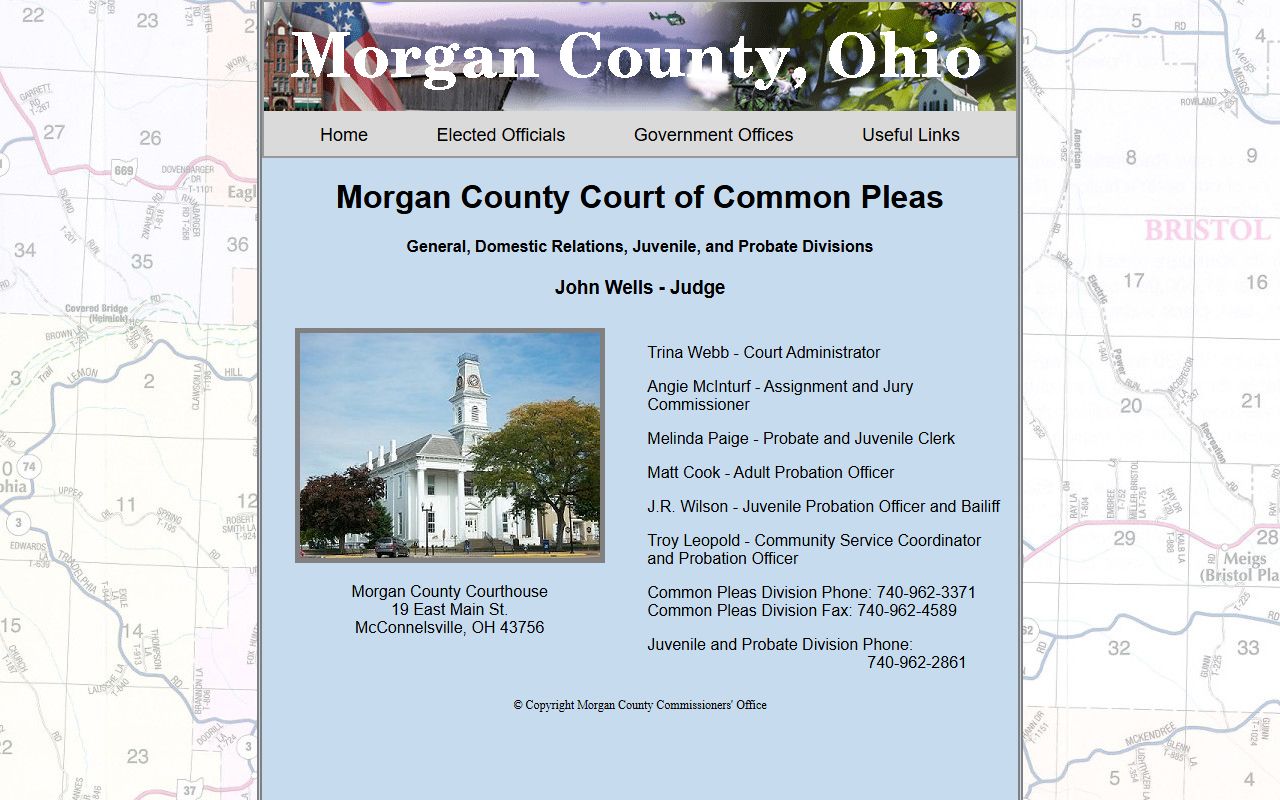
Common Pleas records become especially important when a Morgan County arrest involves a felony, bindover, indictment, sentencing, or prison commitment.
Charges Filed After Arrest
A booking charge on the SEORJ roster is an early jail-management entry. The formal court record is built from charging documents. Prosecutor review can change what appears after arrest, especially in felony cases. A charge may start in County Court and then move to Common Pleas by bindover, information, or indictment.
| Document | Plain Meaning | Morgan County Use |
|---|---|---|
| Complaint | Initial charging document used to start many misdemeanor or preliminary felony cases. | May appear first in County Court or lower-level proceedings. |
| Information | Formal prosecutor charge, often used when indictment is waived. | Common Pleas route when allowed by procedure. |
| Indictment | Formal charge returned by a grand jury. | Common in felony cases after arrest or bindover. |
Morgan County Charge Status
Charge status terms show where the case stands after an arrest. They can differ from the jail roster because a court docket tracks filings, motions, warrants, pleas, dismissals, sentencing, and costs. A single arrest can also lead to more than one case or more than one charge level.
| Status | What It Means |
|---|---|
| Pending | The charge remains open and has not reached final disposition. |
| Amended or reduced | The filed charge changed, often by prosecutor action or plea process. |
| Dismissed | The charge was ended by court order or prosecutor action, subject to the docket details. |
| Bound over | A lower court sent a felony matter toward Common Pleas proceedings. |
| Warrant active or issued | The court entered a warrant event, often tied to failure to appear or violation claims. |
Bond Orders After Arrest
Ohio bond rules are grounded in ORC 2937.011 and Ohio Criminal Rule 46. The SEORJ roster's Total Bail field is useful, but it does not explain every release condition. A zero-dollar line can reflect a recognizance context, a missing amount, a hold, a sentenced status, or another case that still keeps the person in custody.
| Bond Type | How It Works |
|---|---|
| Recognizance or PR | Release based on a written promise to appear and obey court conditions. |
| Cash bond | Money is paid as ordered by the court to secure appearance. |
| Surety bond | A surety or bail agent posts bond when the court allows it. |
| No-bond hold | Release is not authorized on that case or hold until the court or agency acts. |
| Detainer or hold | Another case, county, parole, probation, federal, or immigration agency may block release. |
Morgan County Warrant Events
No official Morgan County Sheriff active-warrant search page was located. CourtView and the court offices are the better public channels for bench warrants tied to cases. A warrant may also show indirectly on the SEORJ roster through charges such as failure to appear, contempt, probation violation, or similar warrant and hold language.
For an active safety issue, call 911. For non-emergency warrant or case questions, the Morgan County Sheriff non-emergency number is (740) 962-4044, and the anonymous tip line is (740) 962-1369. Court-related bench warrant status should be checked with County Court, Common Pleas, or the Clerk of Courts.
Morgan County Charges vs Convictions
An arrest and charge are not the same as a conviction. Court records after a jail arrest can show accusations before any plea, trial, or sentencing. Readers should check the disposition field and docket entries before treating a charge as a final outcome.
| Charge | Conviction | |
|---|---|---|
| Stage | Accusation filed after arrest or investigation. | Final result after plea, verdict, or court finding. |
| Record source | Complaint, information, indictment, docket, or roster charge. | Judgment entry, sentence, disposition, or docket result. |
| Risk of change | Can be amended, reduced, dismissed, or bound over. | Can still be appealed, sealed, or affected by later court orders. |
Sealed and Expunged Records
Ohio sealing law, including ORC 2953.32, can limit public access to eligible criminal records. Sealing is a court process. It is not the same as asking a roster site or a private publisher to remove a link. Juvenile court records also have separate access limits under ORC 2151.14.
| Sealed | Expunged | |
|---|---|---|
| Public visibility | Hidden from general public access when ordered by the court. | Treated as removed or destroyed where Ohio law allows that result. |
| Access limits | Some agencies or courts may retain limited access by law. | Depends on the statute and court order. |
| Best source | Court order and clerk record. | Court order and clerk record. |
Morgan County Prosecutor Role
Ohio counties have a prosecuting attorney. The Morgan County prosecutor decides how state criminal charges are filed, amended, reduced, dismissed, presented to a grand jury, or resolved. The official county officials PDF lists Richard D. "Rick" Welch as prosecuting attorney for the 2025 to 2028 term. The Morgan County Prosecutor's Office victim advocate page lists victim-services contact information at the courthouse.
Victims and witnesses may use the prosecutor's victim advocate for case coordination, while custody alerts can also be handled through VINELink. Those services do not replace the court docket. They add context after a Morgan County arrest has become a filed court case.
Restricted Court Records After Arrest
Some court records after arrest are not fully public. Juvenile records, sealed records, medical information, protected victim details, some ongoing-investigation material, and certain old or archived files may be restricted or unavailable online. Ohio's Public Records Act supports access to public records, but it does not override every court rule or confidentiality statute.
Important: Court records should be verified with the clerk or court before being used for any official decision.